
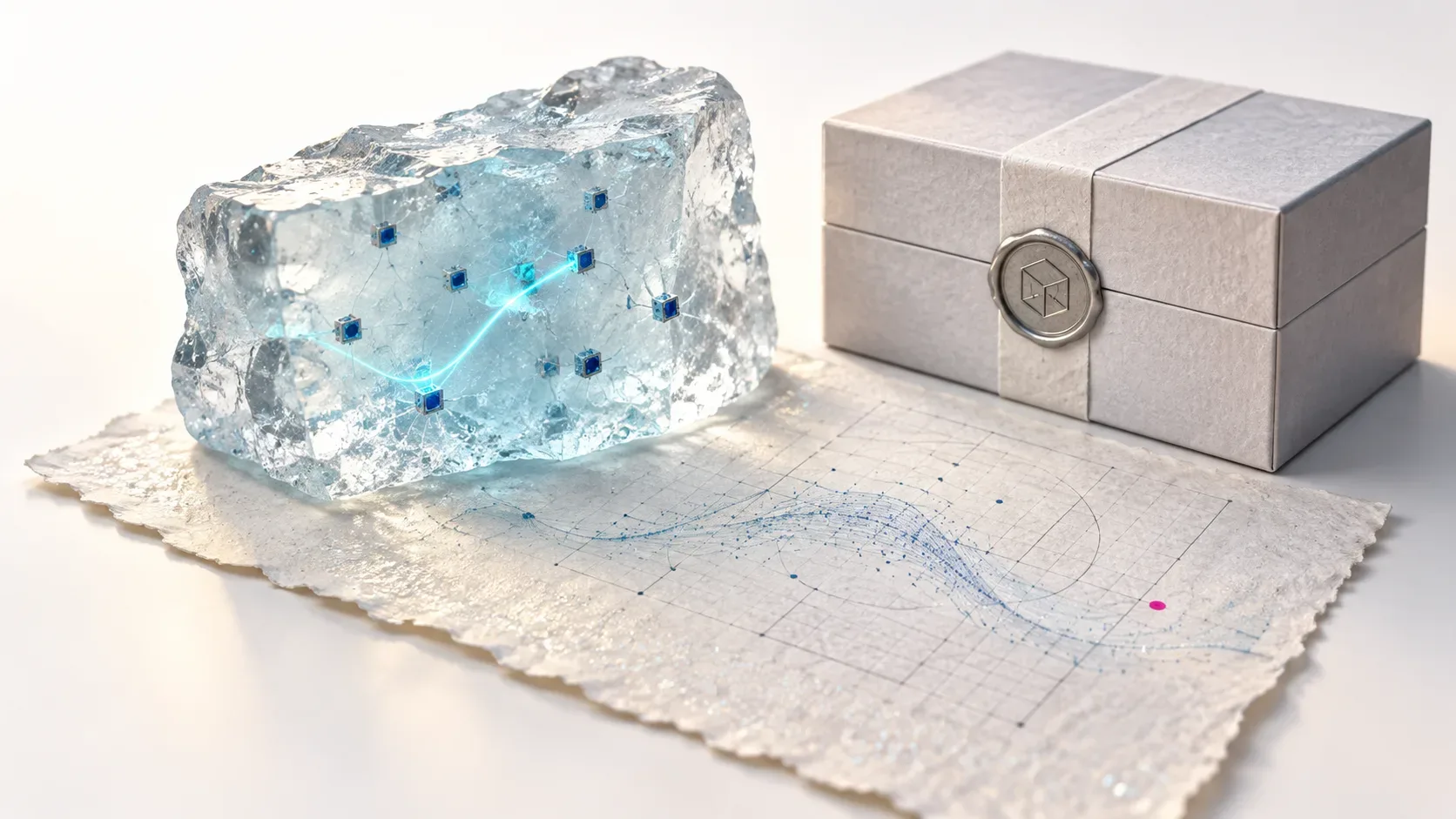
A text mark that lives in word choice, a giant open-weight model that is not yet downloadable, an existing Chinese model newly reachable on Amazon’s managed cloud, and a Nobel for a cubic kilometer of instrumented ice: that is the morning’s mix of software limits and long scientific bets. [1][2][3][4]
Historical edition · Research window: October 5, 05:15–October 6, 05:15 Mountain Time.
OpenAI’s word-choice mark thins when the wording changes
OpenAI is lining up a text-provenance feature for European rules. On the API, the company describes a global opt-in for selected models that stays off unless a developer turns it on. Eligible ChatGPT and Codex use in the European Union is slated for the coming weeks, and that regional path is separate from making the feature a worldwide default. [1]
The signal is statistical. It shows up in which words the model tends to pick, rather than as hidden characters tucked into the file. The matching detector is restricted to approved researchers and expert organizations. OpenAI says it plans to open-source the method later. [1]
OpenAI’s own English evaluation used “explain like I’m five” passages of about 400 tokens. With no synonym replacement, detection was about 92 percent. After 10 percent of the words were swapped for synonyms, detection fell to about 66 percent. At 25 percent replacement, it was about 17 percent. Those are vendor figures from that specific test, so they are not universal error rates for every language, length, or editing style. [1]
Even a clean hit has a narrow job. Detection does not check whether the passage is true, name the user, settle ownership, or measure how much a human contributed. A missing signal also cannot prove that a person wrote the text alone. For anyone hoping a watermark would settle authorship disputes, the interesting part is how little rewriting it takes to push the vendor’s own detection rate down. [1]
Beam’s 501 billion parameters stay behind a waitlist
Reflection introduced Beam as a sparse mixture-of-experts model with 501 billion total parameters and 23 billion active parameters, built for coding, reasoning, and agents, with a one-million-token context window. In a sparse design, the full network is huge, but a given token is routed through a much smaller active slice. That is the architectural claim behind pairing a 501-billion-parameter total with 23 billion active parameters. [2]
What a reader can use this morning is an early-access waitlist. Reflection says the weights will ship under the Apache 2.0 license later in October. They are not downloadable yet, so the open-weight promise is a release plan rather than a file you can pull today. The company has also described compute-efficiency advantages; those claims have not been independently verified, and this edition is not turning them into a leaderboard. [2]
GLM 5.3 becomes a Bedrock option for eligible enterprises
Amazon Web Services says the existing GLM 5.3 model is now available on Amazon Bedrock for eligible enterprise customers. The listing is a managed API, with cross-region inference, both implicit and explicit prompt caching, and service tiers. Z.ai’s official account confirmed the Bedrock availability. It is the same GLM 5.3, reached through AWS, and it is limited to eligible enterprise accounts. [3]
Caching can reuse a stored prefix so repeated instructions do not have to be processed from scratch, and cross-region inference can send a request outside the region where an application usually runs. Both features are reasons for an application review of what gets cached and which regions are allowed. AWS attached no benchmark claims to the post. Amazon materials have also cited conflicting parameter counts, 744 billion in one place and 753 billion in another, so this edition omits a size figure entirely. [3]
Francis Halzen receives the physics Nobel for IceCube
The Royal Swedish Academy of Sciences awarded the 2026 Nobel Prize in Physics to Francis Halzen for the IceCube Neutrino Observatory and the study of high-energy astrophysical neutrinos. The prize is 12 million Swedish kronor. The award recognizes an observatory that was finished in 2011, following an initial vision from 1988. [4]
IceCube turns a cubic kilometer of South Pole ice into a detector by embedding light sensors in the ice. Neutrinos rarely interact with ordinary matter. When one does, the interaction can produce a flash of observable light. That rarity is why the instrument has to be so large: most neutrinos pass through the planet unnoticed, and the science depends on catching the rare collision. Today’s news is the prize for that already-built observatory and for the high-energy astrophysical neutrinos it has recorded. [4]
The key changes at a glance. [1] [2] [3] [4]
| textGrain | Global API opt-in; EU consumer rollout ahead | Detector access initially restricted |
|---|---|---|
| Beam | 501B total / 23B active MoE preview | Apache-licensed weights promised later |
| GLM 5.3 on Bedrock | Existing model on a managed service | Eligible enterprise customers |
| Physics Nobel | Francis Halzen and IceCube | Recognition of established neutrino work |
No matching rows.
References & Works Cited
4 SOURCES-
OpenAI (2026-10-5). Our approach to EU text provenance rules.
https://openai.com/index/eu-text-provenance/ -
Reflection (2026-10-5). Introducing Beam: Reflection’s 501B open-weight model.
https://www.reflection.ai/blog/introducing-beam -
Alex Thewsey (2026-10-5). Introducing GLM 5.3 on Amazon Bedrock.
https://aws.amazon.com/blogs/machine-learning/introducing-glm-5-3-on-amazon-bedrock/ -
The Royal Swedish Academy of Sciences (2026-10-6). The Nobel Prize in Physics 2026.
https://www.nobelprize.org/prizes/physics/2026/press-release/