
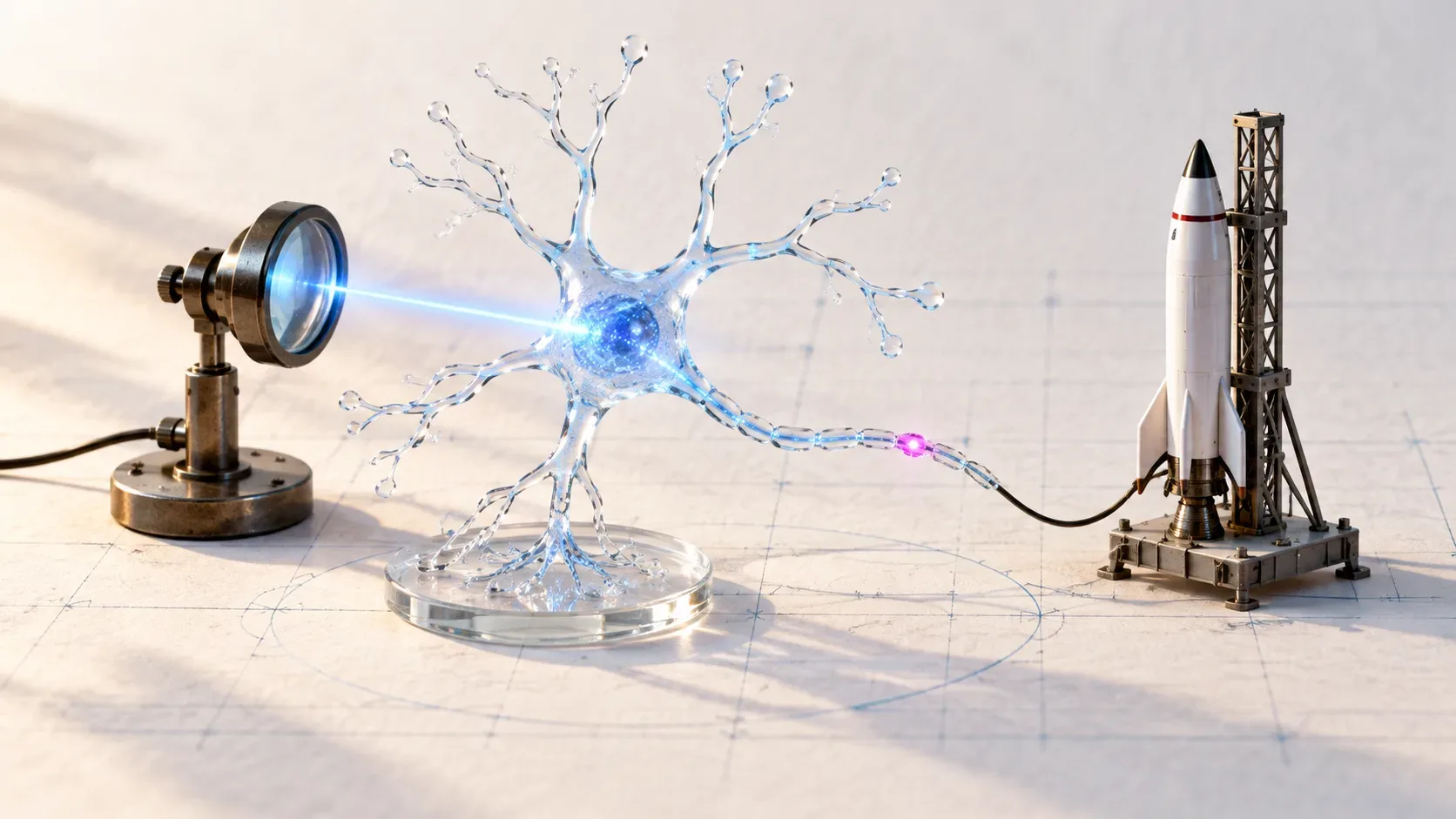
A light-sensitive protein from an alga became one of neuroscience’s most useful experimental tools. This morning, the Nobel Assembly recognized Karl Deisseroth, Peter Hegemann and Georg Nagel for the discoveries behind optogenetics. SpaceX also reported a Falcon 9 auto-abort just before liftoff, with another attempt targeted no earlier than October 6. [1] [2]
Historical edition · Research window: October 4, 05:15–October 5, 05:15 Mountain Time.
Three laureates, one powerful experimental switch
Karl Deisseroth, Peter Hegemann and Georg Nagel jointly receive the 2026 Nobel Prize in Physiology or Medicine for discoveries concerning light-gated ion channels and optogenetics. The 12 million Swedish kronor prize is shared equally. The award connects a discovery in a single-celled organism to a method that lets researchers activate selected nerve cells in a living brain. [1]
Hegemann’s starting question was wonderfully concrete: how does the alga Chlamydomonas swim toward light? Hegemann and Nagel identified channelrhodopsin, a protein on the cell surface. Blue light opens a channel through that protein, allowing charged ions to flow into the cell and create an electrical impulse. Put the protein into other cells and those cells also become sensitive to light. [1]
Deisseroth introduced the gene for channelrhodopsin into rat nerve cells and used blue light to trigger a nerve signal, publishing that advance in 2005. By 2007, the approach worked in living mouse brains. Researchers now had a way to intervene in neural activity with light, rather than only record which cells happened to be active. [1]
Why a controllable input changes brain research
The distinction is cause and effect. Watching a circuit light up alongside a behavior reveals a relationship. Changing the activity of selected cells gives researchers a way to ask what those cells contribute to the behavior. The Nobel Assembly describes optogenetics as a tool for revealing circuits involved in memories, feelings and behaviors relevant to neurological and psychiatric disorders. [1]
That makes the story a strong example of curiosity-driven biology becoming useful engineering. A question about an alga’s movement led to a protein mechanism; transferring that mechanism into neurons produced a controllable experimental input. The useful lesson is how the pieces connect, from molecular discovery to a method researchers can apply to questions about the brain. [1]
Clinical researchers are also investigating optogenetics in attempts to restore sight. The prize announcement describes those efforts as research, and does not establish a general treatment for neurological disease. Its central contribution is already substantial: a way to test causal ideas about neural circuits. [1]
Falcon 9 stops just before T-0
SpaceX reported that a Falcon 9 had an automatic abort just before the scheduled moment of liftoff. The company said the vehicle and payload were in good health, with teams resetting for a launch attempt no earlier than October 6. The public post did not give a cause. [2]
The update leaves a clear operational state for this morning: the attempt stopped before liftoff, and the next date is a target. There is no completed launch to report from that attempt. The company’s health assessment and the revised schedule are the available facts; the reason for the abort remains unstated. [2]
The key changes at a glance. [1] [2]
| Medicine Nobel | Deisseroth, Hegemann and Nagel | Recognition of optogenetics research |
|---|---|---|
| Channelrhodopsin | Light-sensitive ion channel from algae | A research tool for neural circuits |
| Falcon 9 | Auto-abort just before T-0 | No cause stated; next attempt target October 6 |
No matching rows.
References & Works Cited
2 SOURCES-
The Nobel Assembly at Karolinska Institutet (2026-10-5). The Nobel Prize in Physiology or Medicine 2026.
https://www.nobelprize.org/prizes/medicine/2026/press-release/ -
SpaceX (2026-10-5). Falcon 9 auto abort and next launch attempt target.
https://x.com/SpaceX/status/2107033614915690912