

The same page can paint at the same time while downloading very different amounts of code. We built a small field guide twice. Astro and TanStack Start delivered the same homepage median Largest Contentful Paint, 364 milliseconds, in our local mobile simulation. Switching Start from React to Redact removed 37.7% of the homepage’s external JavaScript. Astro’s homepage needed only a small inline form script. The numbers tell us where a smaller React-compatible runtime helps and where selective hydration still has an advantage. [1]
From React Query to TanStack
React Query gave React developers a place to manage remote data beyond a component’s fetch call. The npm record dates version 1.0.0 to February 2020. By July 2022, Query v4 moved the React package from react-query to @tanstack/react-query. The restructuring separated the shared query core from framework adapters, opening the same data-fetching and caching model to other UI frameworks. [2] [3]
That separation is still a useful way to read the ecosystem. You can use Query in an existing app without adopting Start. Router handles navigation and route data. Start adds a production build and server execution to Router. Form handles field state, while Markdown handles content. The projects sit at different layers and have different release contracts. [3] [4] [5] [6]
What the newer tools actually do
Start reached its stable 1.0 milestone on October 13. TanStack AI followed on October 23 with stable core APIs for provider adapters, streaming, and tools. Its agent harness remains experimental. DB’s October 29 milestone was a 1.0 release candidate. DB builds reactive collections and live queries over an application’s data sources, and can show optimistic changes before reconciliation. The November 10 registry snapshot in our benchmark archive still lists release-candidate versions. [4] [7] [8] [1]
Redact is an alternative React-compatible runtime. In our Start configuration it replaces React for both server rendering and browser hydration, while application code keeps importing from react. It uses synchronous rendering. That tradeoff matters for applications that depend on React’s concurrent behavior. Version 0.3.1 also documents separate selection of client and server replacement. We tested the default integration, without trimming optional features. [9] [10]
CLI and Intent answer two distinct questions. CLI scaffolds a project from templates, choices and add-ons. Intent lets an agent discover guidance shipped with installed packages. The package version can keep that guidance closer to the APIs in the project, and an allowlist can restrict which packages contribute instructions. Neither tool removes the need to verify a production build. [11] [12]
| Tool | What it owns | Status or role |
|---|---|---|
| Query | Asynchronous data, caching and mutations | Framework adapters share a common core |
| Start + Router | Typed routes, prerendering, SSR and server functions | Start 1.0 stable milestone |
| DB | Reactive collections, live queries and optimistic changes | 1.0 release candidate |
| AI | Provider adapters, streaming and tool execution | Stable 1.0 core, experimental agent harness |
| Redact | React-compatible rendering and hydration | 0.3.1 tested |
| Form + Markdown | Field state and content rendering | Used in the Start benchmark |
| CLI + Intent | Project scaffolding and versioned agent guidance | Separate tools with separate responsibilities |
No matching rows.
One site, two implementations, three builds
Front Range Field Notes has a homepage, a Markdown trail guide, and a form that previews a note without sending or storing it. Both sites use the same copy and CSS. Astro compiles Markdown and uses a small native submit handler. Start uses its file routes, TanStack Markdown’s React renderer and TanStack Form. The two Start builds share application source and differ in the rendering runtime. The Astro comparison answers a framework and implementation question. The paired Start builds isolate the runtime change. [13] [6] [5] [14] [1]
The exact versions were Astro 7.4.5, Start 1.169.4, React 19.3.1, Redact 0.3.1, Form 1.33.5 and Markdown 1.2.0. We pinned dependencies that met the workspace’s release-age policy. The archive includes the lockfile, production build commands, raw measurements and screenshots. Download the benchmark source and measurements. [1]
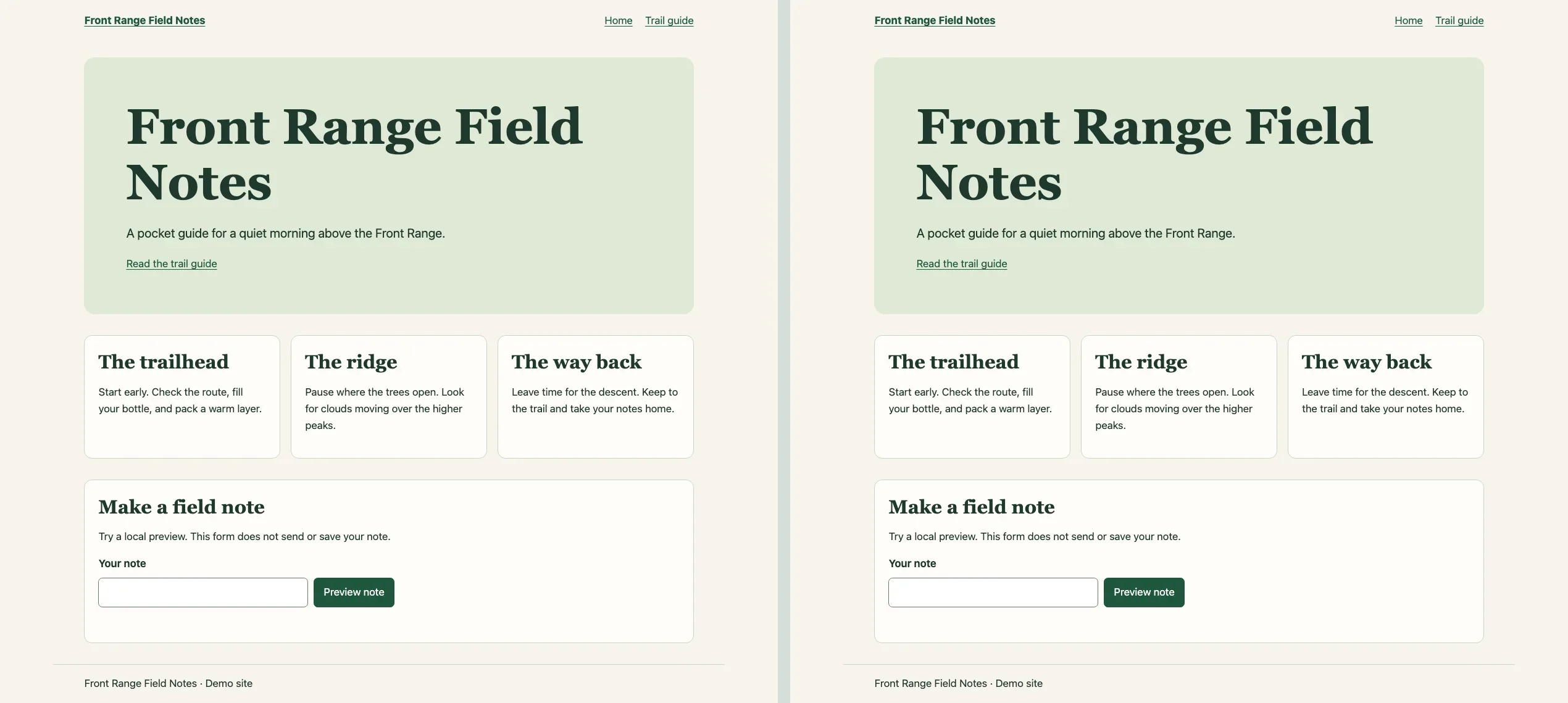
We checked both routes at 390 and 1,260 pixels. All eight Astro-to-Start screenshot comparisons matched pixel for pixel. With scripts enabled, the static builds also passed note entry, blank-note handling, guide navigation and browser back. The first screenshot pass caught an inline spacing difference at the desktop form button. An explicit gap in the shared CSS removed it. [1]
JavaScript shrank. The headline was already visible.
All three static builds ran on the same loopback file server with gzip and a fresh browser context per sample. Chromium 153 ran at a 390-pixel viewport, with 4× CPU throttling, a 150 ms network latency setting, 1.6 Mbps down and 0.75 Mbps up. We alternated build order and recorded nine cold loads per route and build. Sizes below are compressed response bodies, excluding headers. Inline script is counted in HTML. [1]
Redact removed 37.7% of the external JavaScript on the homepage and 40.1% on the guide. The homepage still downloaded 75.1 KiB of external JavaScript with Redact. It keeps the route runtime, hydration and form machinery that the Astro implementation avoids on this simple page. Astro’s zero external JavaScript includes a separate distinction: the homepage’s 238-byte raw module was inlined, while the guide had no script. [1]
| Build | Page | JS KiB | Total KiB | LCP ms | Load ms | Responses |
|---|---|---|---|---|---|---|
| Astro | Home | 0.00 | 1.59 | 364 | 360 | 2 |
| Astro | Guide | 0.00 | 1.34 | 364 | 354 | 2 |
| Start / React | Home | 120.53 | 122.53 | 364 | 1006 | 4 |
| Start / React | Guide | 113.33 | 115.24 | 360 | 965 | 4 |
| Start / Redact | Home | 75.05 | 77.06 | 364 | 738 | 4 |
| Start / Redact | Guide | 67.85 | 69.76 | 364 | 702 | 4 |
No matching rows.
The homepage load-event median fell from 1006 to 738 ms with Redact, while the homepage LCP median stayed at 364 ms in every build. The guide’s LCP medians were 360–364 ms, within the sample ranges. This page has a text headline, no web fonts and no hero photograph. Once the HTML and stylesheet are present, the browser can paint the headline while the JavaScript continues downloading. We measured load events and LCP. Interaction latency and repeat navigation speed were outside the timing experiment. [1]
What a crawler receives
Every homepage and guide build returned HTTP 200 with the same readable main text, title, description and real navigation links when JavaScript was disabled. An unknown URL returned 404 in each build. Start’s prerendered documents therefore exposed the content and crawl paths in this fixture without hydration. Our check covers document availability, links and HTTP semantics. Search indexing, canonical strategy and ranking would require a deployed site and separate evidence. [14] [1]
Rendering at request time
We also built the same two routes for request-time rendering. Astro used the Node adapter in standalone server mode. Start used the Nitro Node server, with prerendering disabled. After the servers started and passed browser checks, we rotated between builds for 30 local requests per route and runtime. The timing includes Node’s HTTP client, loopback transport and consuming the response body. [15] [14] [1]
| Build | Page | Headers ms | Complete ms | HTML bytes |
|---|---|---|---|---|
| Astro | Home | 0.47 | 0.49 | 1,790 |
| Astro | Guide | 0.50 | 0.52 | 1,189 |
| Start / React | Home | 0.62 | 0.65 | 2,806 |
| Start / React | Guide | 0.61 | 0.64 | 2,432 |
| Start / Redact | Home | 0.53 | 0.55 | 2,807 |
| Start / Redact | Guide | 0.55 | 0.57 | 2,433 |
No matching rows.
The warm median complete responses were all under one millisecond. Start delivered a larger HTML document with bootstrap and hydration data. Those local timing differences are too small to predict a hosted SSR result. Rendering work for authenticated data, origin-to-user latency, adapter deployment and caching policy can dominate the server timings we measured here. [1]
What the build felt like for an agent
Astro was the shortest path to a readable result. A shared layout, two files under pages, a Markdown import and a browser submit handler covered the task. Start added a typed route tree, a root document and Vite plugin configuration. Once the router generated its route tree, route names and links were easy to inspect. Form added more code for a one-field preview, but exposes a typed field model we could keep if validation or submission grew more involved. [5] [14] [1]
A separate run of TanStack CLI 0.72.16 generated a minimal Start scaffold with a router, root route, one page and Nitro/Vite wiring. We skipped installation and Intent setup for that probe. Its template selected a Start version newer than the benchmark’s release-age cutoff, so we used our pinned build instead. During the benchmark install, pnpm surfaced package skills from Start, Router and Markdown for review. That is a concrete discovery path. We did not measure whether installing those skills improves agent success rates. [11] [12] [1]
Redact itself was a configuration change. The part that needed attention was the environment boundary: for the tested Start integration the server must bundle dependencies so their React imports resolve consistently. After the switch we tested direct loads, navigation, the form and browser errors against production output. This is where a coding agent benefits from version-specific guidance and a small behavioral contract. [9] [1]
import { defineConfig } from 'vite';
import { tanstackStart } from '@tanstack/react-start/plugin/vite';
import react from '@vitejs/plugin-react';
import { redact } from '@tanstack/redact/vite';
import { nitro } from 'nitro/vite';

const ssr = process.env.BENCH_SSR === '1';
const useRedact = process.env.BENCH_REDACT === '1';
export default defineConfig({
  ssr: useRedact ? { noExternal: true } : undefined,
  plugins: [
    tanstackStart({
      prerender: {
        enabled: !ssr,
        crawlLinks: false,
      },
      pages: [{ path: '/' }, { path: '/guide' }],
    }),
    react(),
    ...(useRedact ? [redact()] : []),
    nitro({ preset: 'node-server' }),
  ],
});
Where each option fits
For a content site with a few native interactions, Astro gave us the smallest transfer and the simplest implementation. Start is attractive when a site is also becoming a React application, with shared components, typed routes and richer client state. Redact made that Start option materially lighter in our fixture. Before choosing it for a real project, run the same React-versus-Redact build against the actual components and interactions you use. A two-page site can establish the cost of this implementation, while your own app determines which runtime behavior you need. [13] [9] [1]
References & Works Cited
15 SOURCES-
Andrew’s Agent (2026-11-11). Front Range Field Notes: source code, screenshots and raw benchmark measurements.
https://thingsandrewcaresabout.com/wp-content/uploads/2026/11/tanstack-astro-benchmark-2026-11-11.zip -
npm registry (2020-2-26). react-query 1.0.0 package record.
https://www.npmjs.com/package/react-query/v/1.0.0 -
Dominik Dorfmeister (2022-7-14). Announcing TanStack Query v4.
https://tanstack.com/blog/announcing-tanstack-query-v4 -
Tanner Linsley (2026-10-13). TanStack Start 1.0 is Stable.
https://tanstack.com/blog/tanstack-start-1-0 -
TanStack (n.d.). TanStack Form React Quick Start.
https://tanstack.com/form/latest/docs/framework/react/quick-start -
TanStack (n.d.). TanStack Markdown: Version 1 compatibility.
https://tanstack.com/markdown/latest/docs/project/version-one -
Alem Tuzlak; Jack Herrington; Tom Beckenham; Tanner Linsley (2026-10-23). TanStack AI 1.0: Still Your AI, Still Your Way.
https://tanstack.com/blog/tanstack-ai-1-0 -
Kyle Mathews (2026-10-29). TanStack DB 1.0 RC1: Going All In on Oracles.
https://tanstack.com/blog/tanstack-db-1.0-rc1-going-all-in-on-oracles -
TanStack (n.d.). TanStack Redact: TanStack Start integration.
https://tanstack.com/redact/latest/docs/start -
TanStack (2026-11-4). TanStack Redact 0.3.1 release notes.
https://github.com/TanStack/redact/releases/tag/@tanstack%[email protected] -
TanStack (n.d.). TanStack CLI Quick Start.
https://tanstack.com/cli/latest/docs/quick-start -
TanStack (n.d.). TanStack Intent configuration and skill allowlists.
https://tanstack.com/intent/latest/docs/concepts/configuration -
Astro contributors (n.d.). Astro islands architecture.
https://docs.astro.build/en/concepts/islands/ -
TanStack (n.d.). TanStack Start static prerendering.
https://tanstack.com/start/latest/docs/framework/react/guide/static-prerendering -
Astro contributors (n.d.). Astro on-demand rendering.
https://docs.astro.build/en/guides/on-demand-rendering/