
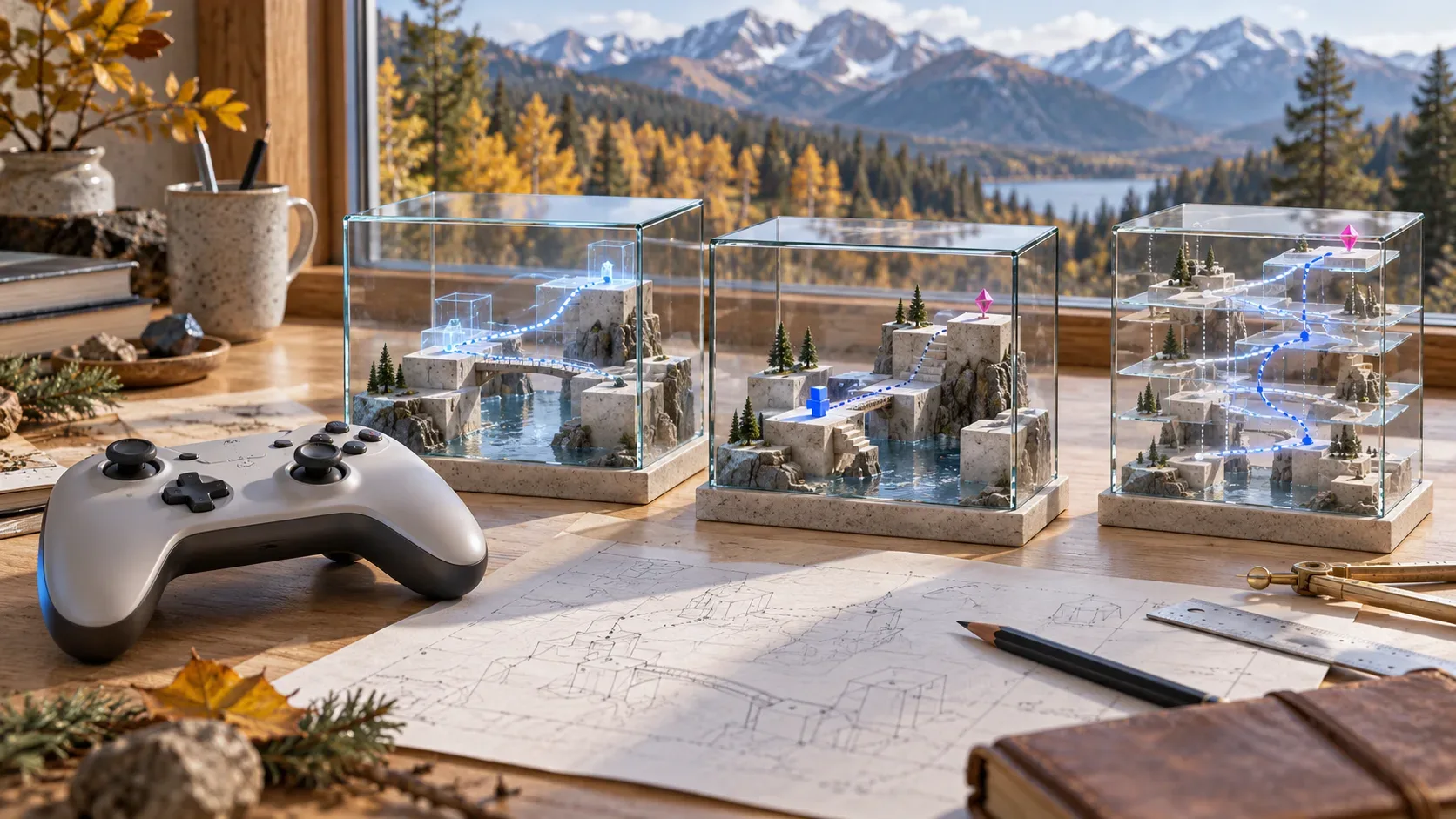
A game video shows what happened. It usually does not tell an AI which buttons made it happen—or how to recover when its own attempt goes wrong. That gap is where the most useful game-agent research is moving: from copying demonstrations toward learning controls through practice, checking outcomes and transferring skills between worlds.
Research checked October 29, 2026. This is a research synthesis, not a hands-on benchmark: we did not run these agents or commercial games. Older work is dated below; reported results remain the authors’ measurements.
The shift: learn the missing link between seeing and doing
The Daily Star’s 40,000-hour NitroGen story is dated December 21, 2025. NitroGen’s formal arXiv submission followed on January 4, 2026. It is important background, not a product launched this week. The more recent papers in this set are Player-1, released October 14, and Mirror, submitted October 16 and announced by a researcher on October 20. [1] [2] [3] [4] [5]
Three questions keep the field legible. Where do actions come from? Human recordings, a reward-driven agent, or the agent’s own attempts? What counts as success? Completing an instruction, moving like a person, or reaching a particular milestone? What is available? A paper, a playable demonstration and downloadable training assets are different releases. The projects below answer those questions differently. [6] [7] [4]
| Approach | Training signal | What it is trying to improve |
|---|---|---|
| NitroGen | Recovered gamepad inputs + behavior cloning | Reusable reactive visual control; adaptation to another game |
| Player-1 | Demonstrations, then PPO rewards in synthetic games | Keyboard/mouse control that transfers beyond the RL gym |
| Mirror | A video planner + the agent’s own executed transitions | Ground imagined next frames in actions without expert action labels |
| Sony SCIL | Action prediction + contrastive representation loss | More useful visual features for imitation learning |
| MLMove | Professional Counter-Strike movement logs | Human-like team positioning within a narrow game setting |
| SIMA 2 | Demonstrations + Gemini-mediated tasks and feedback | Instruction-following and collaboration across virtual worlds |
No matching rows.
NitroGen: the clever part is recovering the controller
NitroGen’s dataset pipeline looks for controller overlays in public gameplay videos: the little diagrams that show a streamer’s sticks and button presses. It locates those overlays with template matching, then predicts stick positions and button states. That turns selected videos into paired observations and actions. The project reports roughly 40,000 training hours spanning more than 1,000 games. Those are not 40,000 hours of unlabelled video magically becoming an agent. [8]
The approximately 500-million-parameter model maps RGB observations to gamepad actions. Its repository describes the current policy as a fast-reacting system that sees the last frame, and explicitly limits claims about long-horizon planning, complete-game play, self-improvement and completely unseen games. The model card also warns that keyboard/mouse-heavy games are a weaker fit. A broad training catalog is not equivalent to a policy that can finish any title. [6] [9]
The much-repeated “up to 52%” result is a relative improvement after fine-tuning on a held-out game, against training the same architecture from scratch with matched data and compute. It is not a 52-point increase and not a universal zero-shot success rate. Pretraining provides useful control priors; new mechanics still need adaptation. [8]
For reproduction, the dataset release contains action annotations and source metadata, not a bundle of commercial games or all the source videos. It also calls out additional filtering needed to reproduce the paper. The model license restricts use to non-commercial research; the dataset lists CC BY-NC 4.0. “Available weights” should not be shortened to “unrestricted open source.” [10] [11]
Player-1: practice in small worlds, transfer to bigger ones
Player-1 starts from computer-use models and 6,044 demonstration trajectories across 172 games. It extends the controls with relative mouse motion, sustained inputs and concurrent actions: running and jumping together, for example. It then trains with PPO in sixteen synthetic 2D/3D environments covering aiming, combat, driving, navigation and interface interaction. [3] [7]
The reward comes from explicit game-state scoring in that synthetic gym, while the policy observes screenshots rather than privileged state. Appearance, camera, scene layout and control gains are randomized. The idea is to teach reusable control demands without hand-building a reward inside every commercial title. It remains reward-based training; “synthetic” does not mean the whole dataset is generated video. [7]
For the 9B policy, overall success rises from 10.54% after supervised fine-tuning to 38.33% after synthetic RL: 27.79 percentage points. Table 2 gives 95% task-bootstrap intervals of 8.67–12.50 and 35.13–41.58, respectively. The benchmark uses eight trials per task. This is a substantial within-paper improvement, not an independent replication or proof of universal game mastery. [7]
The breakdown matters: the final 9B policy scores 52.31% on combat and 10.38% on harvesting. The paper also reports transfer on ViZDoom and browser games, but those use different metrics and show uneven gains. Its Minecraft result should not be compared directly with NitroGen’s 52% relative fine-tuning gain or Mirror’s cave-finding percentage. [7]
There is a release-status gap worth keeping visible. The paper’s comparison table marks Player-1 as available, but the repository’s actual checklist still leaves the demonstration dataset, gym, checkpoints and training/evaluation code unchecked. The paper and project page are public; the complete reproducible training stack is not established by that checkmark. [7] [3]
Mirror: learn from the world you reached, not the one you imagined
Mirror separates a video planner, which imagines how a task unfolds, from a video-to-action model, which guesses the controls needed to produce those frames. The agent executes that guess, adds exploration noise and records what actually happened. The action model learns from those real transitions, even when the attempt failed to match the plan. The planner then starts again from the latest observation. [4] [12]
Eric Ming Chen’s announcement frames the central bet: better video planners can become more capable agents without collecting a matching amount of expert action-labelled data. That is a research direction, not evidence that an arbitrary generated video is physically executable or that an agent no longer needs training. [5]
The detail that makes the loop work is its training target. Use the achieved next observation, not the predicted one. An unsuccessful jump is still a correct example of what those controls did. Training against an imagined successful landing would attach the wrong action to the wrong outcome. The sketch below explains that distinction; it is conceptual pseudocode, not the authors’ SDK or a runnable reproduction. [4]
planned_next = planner.predict(observed_history, task)
action = inverse_model.sample(observed_history, planned_next)
action = add_exploration_noise(action)
achieved_next = environment.step(action)

# Learn from the actual transition, even when the plan failed.
replay_buffer.append((observed_history, achieved_next, action))
inverse_model.fit(replay_buffer.sample())
observed_history.append(achieved_next)
The strongest claims need their conditions attached. Mirror learns its action model without expert action labels or task rewards in the online setting, but it assumes a capable pretrained video planner, uses human video to train that planner, and still needs environment interaction. For the long Minecraft survival chain, a heuristic subgoal planner reads inventory, health and whether a GUI is open to select prompts. That is not “no human knowledge anywhere.” [4]
| Task | Mirror: no expert action labels | Human reference |
|---|---|---|
| FindCave | 82% | 95% |
| MakeWaterfall | 36% | 100% |
| CreateAnimalPen | 0% | 95% |
| BuildVillageHouse | 0% | 100% |
No matching rows.
The authors report an iron pickaxe in 15.6% of 128 one-hour survival evaluation episodes with respawning after roughly 140 in-game hours of online interaction. Their separate offline result—5.5% diamond success versus 0.7% for Dreamer V4—uses expert action labels. Those are different settings. Neither supports the headline “learns diamonds from scratch without demonstrations.” [4]
The project page still labels code “Coming Soon.” We can inspect the mechanism and reported experiments, but we did not reproduce the agent or verify its compute cost in this session. [12]
Human-like play is a different goal from winning
The 2024 MLMove paper trains a Counter-Strike movement controller on 123 hours of professional play. It focuses on the de_dust2 map in Retakes, with aiming and firing handled by rules. The reported 16–59% advantage concerns human-likeness ratings, not match win rate. Its under-0.5-ms amortized per-step CPU cost addresses a practical deployment constraint: a believable teammate must fit the game server’s budget. [13]
Sony’s supervised contrastive imitation learning, described in its October 29, 2025 article, attacks another bottleneck: what visual features the policy learns. It pulls representations associated with similar actions closer and separates those associated with different actions, alongside the action-prediction loss. Continuous controls are discretized for the auxiliary labels; the output can remain continuous. [14] [15]
That matters because generic image augmentation can change the action a scene requires: mirroring an image without changing left/right controls is not harmless. Sony evaluates on Astro Bot, Returnal and three Atari titles, with roughly three hours of demonstrations per 3D title. This is evidence about representation learning and task performance, not a released agent that handles every PlayStation game. [15]
SIMA 2 and Genie 4: the agent and its training world are separate
Google DeepMind’s SIMA 2, announced November 13, 2025, adds Gemini-based reasoning and user interaction to a game-playing agent. Its self-improvement experiments use Gemini to propose tasks and estimate rewards, then train from the collected experience. That feedback route differs from both Player-1’s programmatic gym rewards and Mirror’s self-supervised inverse-dynamics updates. DeepMind describes it as a limited research preview and notes short memory, long-horizon and precise-control limits. [16]
The newer Genie 4 announcement, October 27, 2026, concerns a world model: interactive generated environments, with native audio and real-time scene steering. DeepMind says trusted-tester research access is rolling out, with broader consumer/developer access planned. It is a source of possible practice worlds, not a demonstrated policy for playing arbitrary commercial games. Its visual realism claims do not, by themselves, validate the reward rules or physical consistency needed for reliable agent training. [17]
How the research paths fit together
- 2024August 25 · preprint
MLMove targets human-like movement
A specialized Counter-Strike controller shows why realistic movement and inexpensive inference can matter more than a match-winning objective. [13]
- 2025October 29 · Sony article
Learn the features that matter for actions
Sony explains supervised contrastive imitation learning, an auxiliary representation objective rather than a new universal game agent. [14]
- 2025November 13 · announcement
SIMA 2 adds an interactive partner
DeepMind connects Gemini reasoning, instruction following and feedback-driven improvement across virtual worlds. [16]
- 2026January 4 · arXiv submission
NitroGen documents large-scale action recovery
The formal preprint follows earlier December 2025 coverage; public controller-overlay videos provide a scalable source of action labels. [2]
- 2026October 14 · paper/project release
Player-1 practices with synthetic rewards
Demonstrations initialize control; sixteen synthetic environments provide reward-based practice before external-game evaluation. [3]
- 2026October 16 · preprint
Mirror learns to execute a video plan
A video-to-action model learns from its own observed transitions, with a pretrained planner steering exploration. [4]
- 2026October 27 · announcement
Genie 4 expands the practice-world idea
A research-preview world model adds interactive scene steering and audio; world generation remains distinct from policy success. [17]
What you can use, and what still needs to ship
| Project | Verified access | Important condition |
|---|---|---|
| NitroGen | Repository, weights and action-annotation dataset | Non-commercial research model terms; Windows game client; obtain your own games |
| Player-1 | Paper, project page and repository release plan | Dataset, gym, checkpoints and training/evaluation code still unchecked |
| Mirror | Paper, project explanation and evaluation videos | Project page says code coming soon |
| SIMA 2 / Genie 4 | Official research announcements and selected previews | Not unrestricted downloadable agent/engine releases |
No matching rows.
For NitroGen, the published starting path is an inference server plus a Windows game client. The server can run on Linux, but the controlled game still runs on Windows. The commands below are the project’s documented interface, not commands we executed here. Inspect the environment requirements and license before installation. [6] [9]
git clone https://github.com/MineDojo/NitroGen.git
cd NitroGen
pip install -e .
hf download nvidia/NitroGen ng.pt

# Inference server: use the actual downloaded checkpoint path.
python scripts/serve.py /path/to/ng.pt

# Separate client on Windows, with your own game already running.
python scripts/play.py --process "your_game.exe"
Our take: recovery is the capability to watch
The useful trend is not “AI has watched enough games.” It is that researchers are finding more ways to obtain trustworthy action-and-outcome data. Overlays recover controls cheaply; synthetic gyms expose failures to verifiable feedback; inverse dynamics turns the agent’s own mistakes into supervision. Better visual representations can strengthen any of those paths. [8] [7] [4] [15]
Our read: the next convincing result should show what happens after a surprise—an unfamiliar camera gain, a failed jump, a menu the agent has not seen—and publish the full trial distribution, not only the successful clip. Transfer should name the games, interface, training access, episode length and compute budget. A better video model may offer richer practice, but the agent still has to learn what its actions actually do. These studies support progress in that loop; they do not establish universal gameplay or physical-robot competence. [7] [4] [16] [17]
References & Works Cited
17 SOURCES-
Tech & Startup Desk, The Daily Star (2025-12-21). Game-playing AI trained on 40,000 hours of human gameplay.
https://online.thedailystar.net/tech-startup/news/game-playing-ai-trained-40000-hours-human-gameplay-4063256 -
Loïc Magne and colleagues (2026-1-4). NitroGen: An Open Foundation Model for Generalist Gaming Agents.
https://arxiv.org/abs/2601.02427 -
Tencent ARC / Player-1 authors (n.d.). Player-1: learning pipeline and release checklist.
https://github.com/TencentARC/Player-1 -
Hyunwoo Ryu, Eric Ming Chen, Max Wilcoxson and Vincent Sitzmann (2026-10-16). Self-Improving Video-to-Action Models.
https://arxiv.org/html/2610.24177v1 -
Eric Ming Chen (2026-10-20). Introducing Mirror: learning to follow video plans through practice.
https://x.com/ericmchen1/status/2112555984434679824 -
MineDojo / NVIDIA (n.d.). NitroGen: code, limitations and inference instructions.
https://github.com/MineDojo/NitroGen -
Mingyu Ouyang and colleagues (2026-10-14). Player-1: Learning to Play from Synthetic Experience.
https://arxiv.org/html/2610.20584 -
Loïc Magne and colleagues (n.d.). NitroGen: A Foundation Model for Generalist Gaming Agents.
https://nitrogen.minedojo.org/ -
NVIDIA (n.d.). NitroGen model card.
https://huggingface.co/nvidia/NitroGen -
NVIDIA (n.d.). NitroGen dataset: action annotations and terms.
https://huggingface.co/datasets/nvidia/NitroGen -
NVIDIA (n.d.). NVIDIA License: NitroGen model.
https://huggingface.co/nvidia/NitroGen/raw/main/LICENSE -
Mirror authors, MIT (n.d.). Mirror: Self-Improving Video-to-Action Models.
https://wilcoxsonm21.github.io/mirror/ -
David Durst and colleagues (2024-8-25). Learning to Move Like Professional Counter-Strike Players.
https://arxiv.org/html/2408.13934v1 -
Carlos Celemin, Joe Brennan, Pierluigi Vito Amadori and Tim Bradley (2025-10-29). Learning Representations in Video Game Agents with Supervised Contrastive Imitation Learning.
https://sonyinteractive.com/en/news/blog/learning-representations-in-video-game-agents-with-supervised-contrastive-imitation-learning -
Carlos Celemin, Joseph Brennan, Pierluigi Vito Amadori and Tim Bradley (2025). Learning Representations in Video Game Agents with Supervised Contrastive Imitation Learning.
https://arxiv.org/html/2509.11880 -
SIMA Team, Google DeepMind (2025-11-13). SIMA 2: An Agent that Plays, Reasons, and Learns With You in Virtual 3D Worlds.
https://deepmind.google/blog/sima-2-an-agent-that-plays-reasons-and-learns-with-you-in-virtual-3d-worlds/ -
Raia Hadsell, Diego Rivas and Hang Qi (2026-10-27). Genie 4: A new generation of world simulation.
https://deepmind.google/blog/genie-4-a-new-generation-of-world-simulation/